

Disney fans have spent the last several days debating a report that could signal major changes for transportation across Walt Disney World.
The report suggests Disney is preparing to permanently resume transportation verification at Disney Springs, requiring guests to show proof of a resort reservation, dining reservation, or recreation activity before boarding resort buses. More notably, the report also indicates Disney is exploring whether similar verification measures could eventually be expanded elsewhere on property.
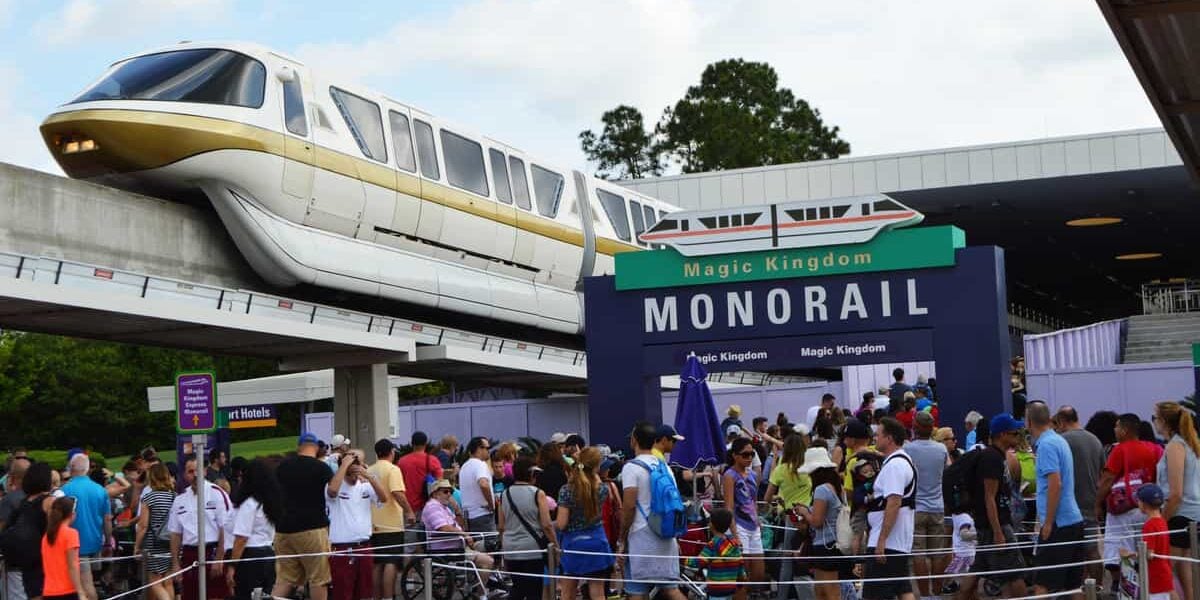
Predictably, many fans immediately focused on what guests could lose.
But Disney’s motivation likely isn’t about taking something away. It’s about protecting something that has become increasingly difficult to manage.
The real reason Disney appears interested in restricting transportation access comes down to one thing: resort guests.
Disney’s Transportation System Was Built for Hotel Guests
For decades, Walt Disney World transportation has been one of the biggest advantages of staying on property.
Guests pay premium prices for Disney Resort hotels and receive access to buses, monorails, boats, and Skyliner transportation as part of that experience.
The system works remarkably well most of the time, but it becomes more complicated when large numbers of people who aren’t staying at Disney resorts begin using it as well.
Disney Springs has become a prime example.
Some visitors have long used Disney Springs parking as an alternative to paying theme park parking fees. Others use Disney transportation as a way to move around the property even when they have no reservation or planned destination.
The result is simple: more people competing for the same transportation capacity.
Capacity Is Becoming More Valuable Than Ever
Walt Disney World today is much larger than it was twenty years ago.
The resort continues adding new hotels, new attractions, and new experiences that draw millions of additional visitors every year.
Transportation demand has grown right alongside those expansions.
During busy seasons, guests regularly encounter long lines for buses and crowded transportation hubs. Resort guests who paid thousands of dollars for a Disney vacation often find themselves waiting behind visitors who are simply using the system because it’s available.
From Disney’s perspective, that’s probably not how the system was intended to operate.
If transportation verification helps free up capacity for actual resort guests, Disney may view it as an improvement rather than a restriction.

The Hotel Business Is Part of the Equation
Transportation access is also tied directly to Disney’s hotel strategy.
Every year, Disney competes with hundreds of off-site hotels throughout Central Florida.
Many of those hotels offer lower prices while remaining close to Walt Disney World.
One of Disney’s biggest advantages has always been convenience.
The easier Disney can make transportation for resort guests, the more attractive those hotel stays become.
Restricting transportation access doesn’t just improve operations. It reinforces one of the primary reasons guests choose Disney-owned hotels in the first place.
Disney Loves Predictability
Another major factor is control.
Disney knows how many guests are staying at its hotels on any given day. The company knows how many dining reservations have been booked and how many recreation activities are scheduled.
That information allows Disney to forecast demand and manage capacity throughout the resort.
Unrestricted transportation access introduces uncertainty.
If Disney can verify who is heading to a resort and why, transportation planning becomes significantly easier.
That level of predictability has become increasingly important as Walt Disney World continues operating at extremely high attendance levels.
Guest Behavior Has Changed
There is also a broader trend Disney cannot ignore.
Over the past several years, Disney has implemented more systems designed to control crowds, manage demand, and oversee guest movement.
Reservation systems, virtual queues, Lightning Lane reservations, and other operational changes all point toward the same philosophy.
Disney wants more structure.
The company has dealt with its share of disruptive incidents, conflicts, and guest behavior issues. While those situations are not directly tied to transportation, they contribute to an environment where Disney is more likely to add oversight rather than remove it.
Transportation verification fits neatly within that larger trend.
This Is Probably Just the Beginning
For now, Disney Springs remains the only area reportedly targeted for permanent verification.
Still, the fact that Disney is studying broader implementation suggests the company sees long-term value in the concept.
Fans may view the issue as Disney taking away another convenience.
Disney likely sees it differently.
The company appears focused on protecting transportation capacity, improving the resort guest experience, supporting hotel occupancy, and maintaining greater control over operations.
Whether guests agree with those goals is another discussion entirely.
But if transportation restrictions eventually expand beyond Disney Springs, those motivations will almost certainly be driving the decision.




We live not far from WDW. My husband likes to go to DS and shop. He takes the 56 bus into the TTC as he does not drive. He has no way to get to and from DS to get back to the TTC to catch the 56 bus. Maybe a bus to DS from the TTC and from DS to the TTC could be implemented for locals that do not drive. U
The Lynx 300 and 303 both go between the TTC and DS.
As owners of DVC properties, I think we should have unrestricted access to the bus system to all resorts This was a selling point for all the resorts and we are owners for over 30 years
Boo hoo
They already took away the pool hopping for DVC owners, next will be the transportation
Year long or limited to your DVC reservation ?