Disney’s ‘2D Overhaul’: Why 3D Effects Are Disappearing From the Parks

Disney has spent decades building its parks around the idea that every generation of attractions should feel more advanced than the last. Audio-Animatronics, projection mapping, trackless ride systems, and increasingly immersive storytelling all helped turn a simple ride into something that feels much bigger. For a long time, 3D effects were part of that formula.
Now, though, Disney seems to be easing away from that approach.
The shift has not arrived with a big announcement or a major marketing push. Instead, it has happened quietly, through updates that remove one of the most recognizable parts of certain attractions: the 3D glasses. That kind of change might sound minor, but it says a lot about where Disney’s ride design may be heading next.
What makes this especially interesting is that Disney is not moving away from immersion. If anything, the company appears to be looking for ways to make attractions feel smoother, cleaner, and easier for guests to enjoy.
Disney Technology Never Stays Still
Disney rarely leaves ride technology untouched for long. As projection systems improve and ride vehicles become more advanced, older techniques can become less necessary. What once seemed groundbreaking can eventually become just another effect that the company no longer needs to rely on.
That appears to be the case with some 3D elements.
Modern screens look sharper. Motion-based attractions have become more refined. Trackless systems offer greater flexibility in how stories unfold. Because of all that, Disney can now create depth and scale without always requiring glasses.
In the past, 3D helped digital scenes feel more alive. It gave flat images an extra dimension and made screen-based moments more convincing. But as the technology around those visuals continues to improve, Disney seems more comfortable stepping away from older methods and letting the updated ride systems do more of the work.

3D Has Been Part of Disney’s Modern Ride Formula
This change is notable because 3D has played a major role in Disney parks for years.
Some of the company’s best-known attractions still use it. Avatar: Flight of Passage at Animal Kingdom uses 3D projection to make guests feel like they are flying across Pandora. Toy Story Mania! Hollywood Studios turns its game screens into a 3D midway competition. Star Tours – The Adventures Continue also uses 3D visuals to place riders in the middle of a fast-moving space adventure.
Disney has used the format across all kinds of experiences, from simulators to interactive rides to theater-style attractions. For many fans, 3D became one of the defining features of modern Disney design.
That is why the latest change at EPCOT has drawn so much attention.

One Adventure Signals Something Different
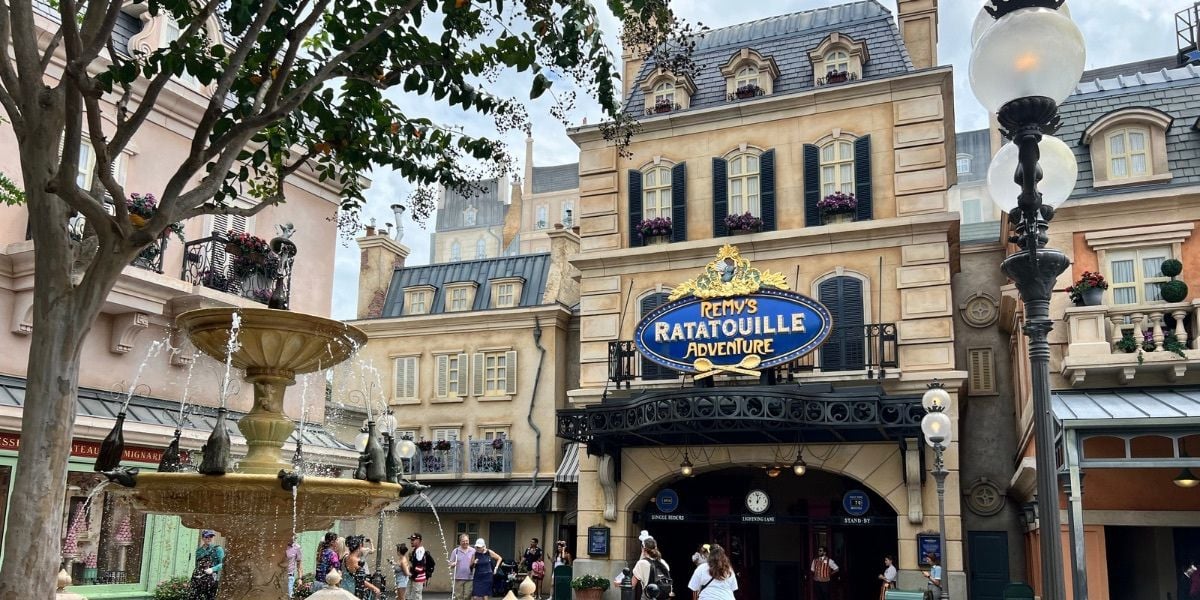
Remy’s Ratatouille Adventure once leaned heavily on 3D glasses to sell its oversized world. Guests boarded trackless vehicles, shrank down to Remy’s point of view, and moved through a kitchen full of giant props and projected scenes that felt larger than life.
Now, the glasses are gone.
Guests can ride the attraction without putting on any extra eyewear, while the experience still uses projection screens and physical sets to tell the story. Disney adjusted the presentation so the attraction still works without the added 3D layer.
That is a meaningful update, because it suggests Disney believes the ride can succeed without one of the tools it originally depended on. Once that happens on a major attraction, it is only natural for fans to wonder whether more rides could eventually follow.
Why Disney May Be Reconsidering 3D
One possible reason is guest comfort. Motion-based attractions already challenge riders with movement, screens, and shifting visuals. Adding 3D on top of that can make some people feel dizzy or nauseous, even if they usually handle rides well. When the eyes and body send different signals to the brain, the experience can become uncomfortable fast.
Another reason may be sanitation. Shared glasses create another step in the ride process. Cast members have to collect them, clean them, and prepare them again for the next group. Even beyond operations, some guests simply do not love the idea of wearing glasses that countless others have already used.
Maintenance also matters. 3D systems require careful calibration, and when that balance slips, visuals can look blurry instead of immersive. As screens age and equipment needs more attention, Disney may see fewer reasons to hold onto an extra layer of technology that newer projection systems can partly replace.

A Simpler Experience May Be the Future
This shift does not suggest Disney is giving up on immersive attractions. It suggests the company may be refining how that immersion works.
If guests can still enjoy rich visuals, physical sets, and detailed storytelling without glasses, Disney gains a smoother, more practical ride experience. That can mean fewer hassles for guests, fewer operational steps for cast members, and fewer technical problems behind the scenes.
Whether this approach spreads to more attractions is still unclear. But Remy’s Ratatouille Adventure shows that Disney is at least willing to test what happens when 3D is no longer essential.
And in a park system built on constant change, sometimes the next big step forward looks a lot simpler than the one before it.