Among the countless legends that make up the history of Walt Disney Parks, none quite compares to the day Winnie the Pooh took the witness stand in a California courtroom. Whenever the story pops up on social media, fans love repeating the viral summary: a Disneyland cast member was accused of hitting a young girl, showed up to court wearing the Winnie the Pooh costume, and watched the case fall apart on the spot.

While the real-life courtroom drama from April 1980 is every bit as surreal as internet folklore suggests, the true story behind the famous “Winnie the Pooh trial” is a fascinating collision of theme park history, strict Disney character rules, and a physical demonstration that demolished a six-year-old lawsuit in just 21 minutes.
How a 1974 Disneyland Shift Turned Into a Six-Year Lawsuit
The unusual saga started six years before the trial, in 1974, at Disneyland in Anaheim, California. Park cast member Robert Hill clocked in for a routine character shift and stepped into the Winnie the Pooh costume. At the time, Disney’s costumed character suits were vastly different from the articulated, lightweight, expressive designs seen in the parks today. The 1970s Winnie the Pooh suit was bulky, rigid, and notoriously difficult to maneuver inside, featuring an oversized, fur-covered fiberglass head and short, stuffed stub arms positioned low on the bear’s torso.

According to Hill’s later courtroom testimony, trouble began while he was greeting guests inside the park. A young girl approached him from behind and started pulling at the back of his costume. Inside the heavy suit, peripheral vision was severely restricted, and turning around meant rotating the entire bulky costume rather than simply glancing over a shoulder. When Hill turned around to see what was happening behind him, he accidentally made contact with the girl—clipping her with the rigid, fur-covered ear of the oversized Pooh head.
At the time, the girl’s family believed the contact was deliberate. They quickly filed a complaint with Disneyland, accusing Hill of intentionally striking their daughter. Eventually, the family escalated the matter into a civil lawsuit against both Robert Hill and Walt Disney Productions, claiming the alleged blow had caused bruising and recurring headaches, and demanding financial compensation from Disneyland.
Strict Disney Rules Forced Winnie the Pooh Into Court
When the case finally reached a California courtroom in April 1980—six years after the incident inside the park—Disney’s defense team faced a unique tactical challenge. To win the case, attorneys needed the jury to see firsthand how restrictive, heavy, and awkward a 1970s theme park costume actually was. Describing the suit’s blind spots and rigid construction in testimony was one thing; showing the jury in person was far more persuasive.
However, bringing the costume into a public courtroom ran straight into one of Walt Disney Productions’ strictest operational rules: character integrity. In 1980, Disney strictly forbade displaying an empty or “broken-down” character costume in public view, as seeing a lifeless, headless suit would ruin the magic and illusion surrounding beloved icons like Winnie the Pooh. If the jury was going to inspect the Pooh costume to understand what happened in 1974, someone had to be wearing it.
During the trial, Robert Hill first testified out of costume, explaining under oath his limited visibility, the suit’s physical constraints, and Disneyland’s strict training that prohibited performers from ever retaliating against guests. Then, following a brief recess, Hill stepped into the costume backstage and returned to the courtroom in full character as Winnie the Pooh.
Head Nods, Belly Wiggles, and a 21-Minute Verdict
The moment Winnie the Pooh walked through the courtroom doors, a routine civil trial transformed into one of the most memorable scenes in California legal history. True to Disneyland’s strict performance standards, Hill refused to break character for even a second once he stepped back onto the witness stand.

Because costumed Disney characters are strictly forbidden from speaking in public, Hill answered questions from attorneys entirely through silent pantomime—communicating with the judge and jury through exaggerated head nods, foot stomps, and expressive belly movements. Watching the beloved resident of the Hundred Acre Wood silently act out testimony from the witness box brought bursts of laughter across the packed courtroom, winning over spectators, court staff, and jurors alike.
Behind the humor, however, the in-costume demonstration delivered a decisive legal blow. When Disney’s defense attorney asked Pooh to demonstrate his full range of motion, Hill raised the costume’s short, unarticulated arms as high as they could physically go.
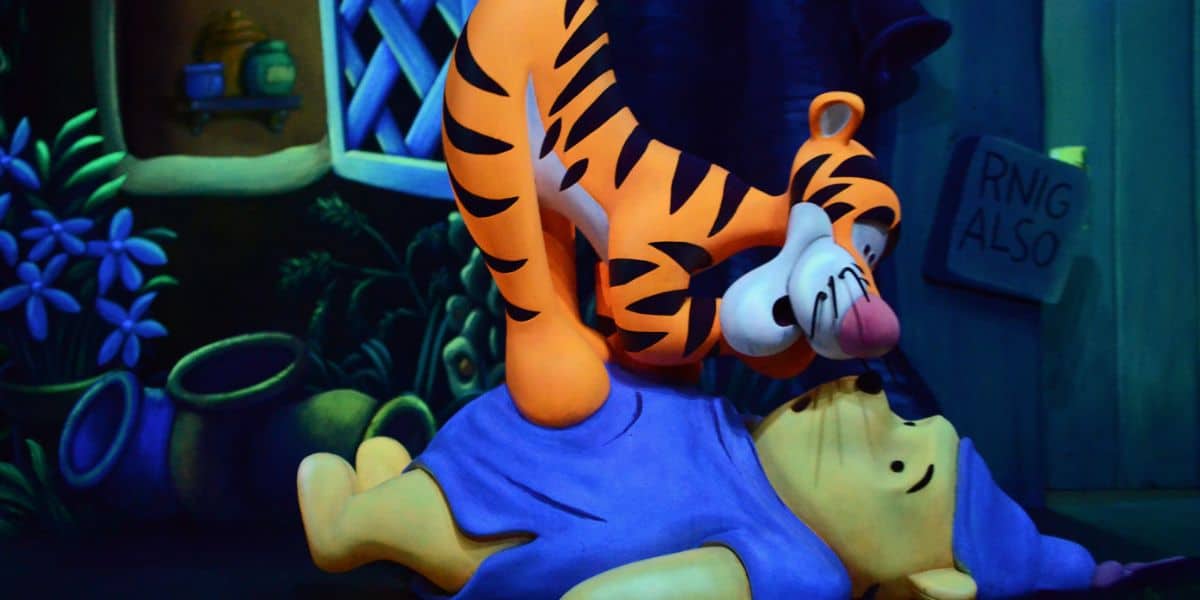
The visual proof was immediate and undeniable. Because the 1970s Winnie the Pooh suit featured short, stuffed arms sewn low on the torso, the costume’s paws could barely reach waist-to-chest height—nowhere near high enough to strike a young girl on the head or face as described in the family’s complaint. What had sounded like a plausible accusation on paper suddenly looked physically impossible right in front of the jury box.
A Legendary Chapter in Disneyland History
With the physical limitations of the costume laid bare for everyone in the courtroom to see, the outcome of the six-year legal battle was virtually sealed. After hearing the remainder of the evidence and closing arguments, the jury retired to deliberate. They needed just 21 minutes to reach a unanimous verdict, ruling completely in favor of Robert Hill and Walt Disney Productions and clearing both the cast member and the company of any wrongdoing.

Although viral social media posts often compress the tale into a rumor that charges were instantly dropped the moment the actor walked through the door, the reality of the April 1980 verdict is even better. Not only did Winnie the Pooh stand trial under oath while staying 100 percent in character, but the physical reality of his own stubby arms proved his innocence faster than a pot of honey disappears in the Hundred Acre Wood.
More than four decades later, the 1980 Winnie the Pooh lawsuit remains one of Disneyland’s most entertaining and frequently retold courtroom stories—a testament to just how seriously Walt Disney Productions has always taken character integrity, and proof that even under oath, Winnie the Pooh knows how to win over a jury.