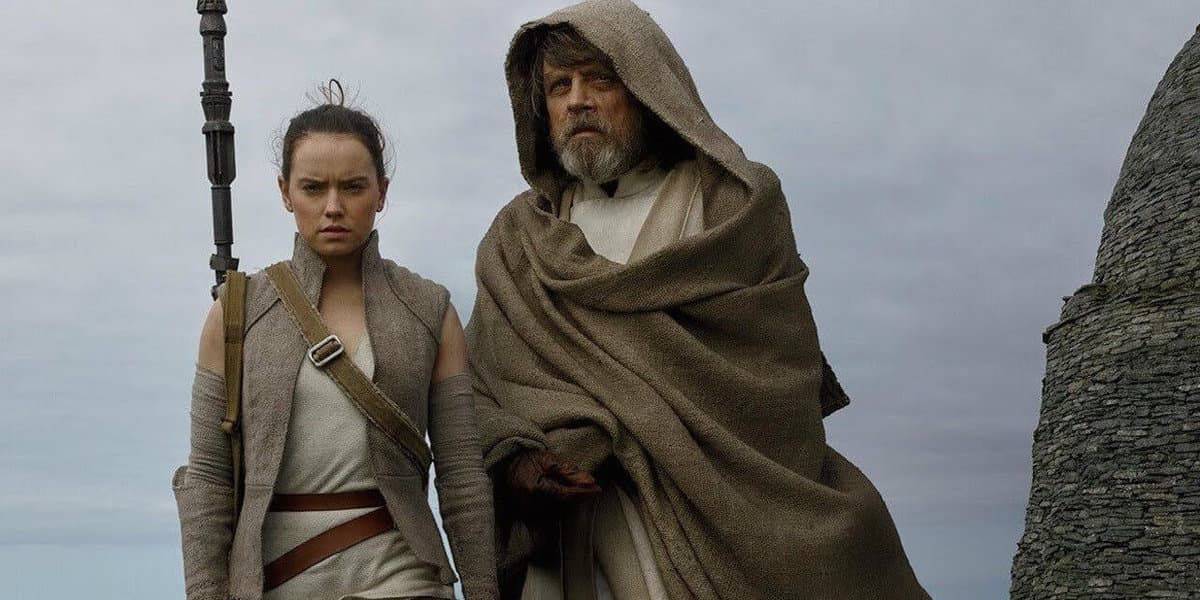
Rian Johnson Admits That He Wanted To Divide Fans With ‘Star Wars: The Last Jedi’

Star Wars: The Last Jedi has remained one of the most polarizing entries in the franchise since its release in 2017. Years after its debut, the film continues to resurface in fan discourse, particularly when its director, Rian Johnson, revisits the ideas that shaped his approach.
Released as the eighth installment in the Star Wars saga, the film functioned as the middle chapter of Disney’s sequel trilogy. However, Johnson’s creative choices departed sharply from franchise tradition. The film questioned the moral authority of the Jedi Order, reframed Luke Skywalker (Mark Hamill) as a disillusioned exile, and emphasized failure as a central theme.

Backlash extended beyond narrative disagreements. Online debate quickly centered on whether The Last Jedi respected established lore or intentionally dismantled it. For many fans, the film symbolized a broader concern about Disney’s stewardship of Star Wars.
Rey (Daisy Ridley) became a focal point of that criticism. Some viewers rejected her rapid mastery of the Force, arguing that her arc lacked sufficient development when measured against earlier protagonists. Others viewed her storyline as a deliberate rejection of lineage-based power.
The film’s portrayal of Rey’s evolving connection with Kylo Ren (Adam Driver) – whose canceled solo film was recently revealed by Driver – further complicated reactions. Their Force-bonded conversations and moral ambiguity unsettled fans accustomed to clearer distinctions between hero and villain, intensifying long-standing divisions within the fandom.
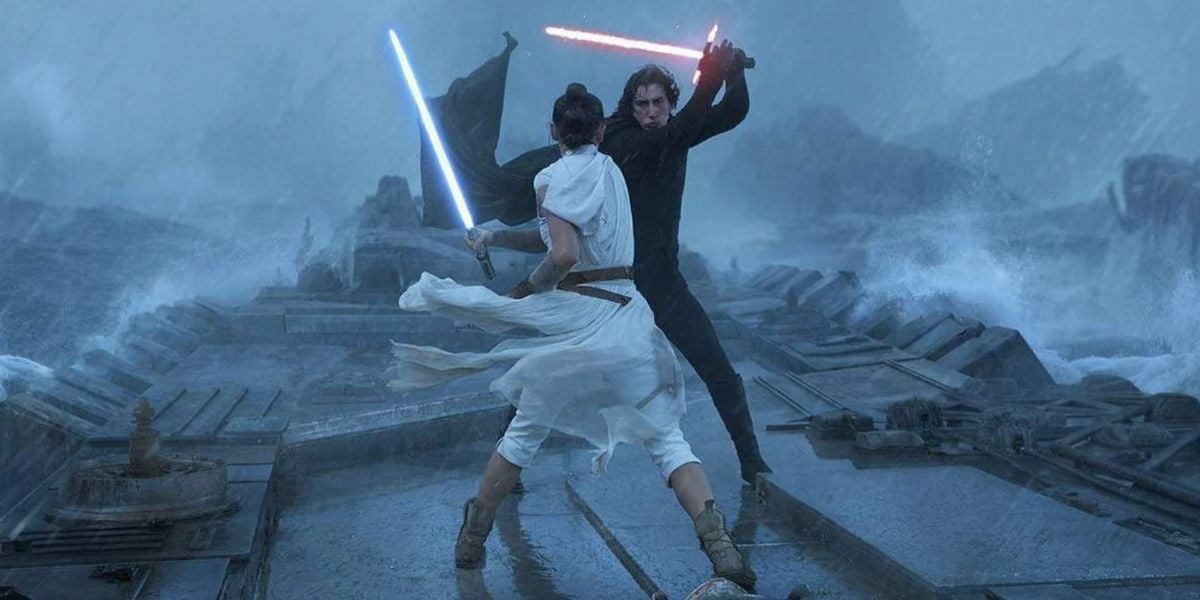
Over time, The Last Jedi became shorthand for a larger debate about what Star Wars should be — a preservation of myth or a reexamination of it. That tension has persisted long after the film’s theatrical run.
Rian Johnson on Faith, Belief, and ‘Star Wars’
In an interview with Polygon to discuss his newest film, Wake Up Dead Man (2025), Johnson addressed how belief systems have influenced his work. While promoting the next Knives Out installment, he drew connections to The Last Jedi.
Johnson described Wake Up Dead Man as an examination of faith, hypocrisy, and distorted belief. He acknowledged that those themes were not new and had informed his approach to Star Wars as well.

“Absolutely, on a couple of different levels,” Johnson said when asked whether the two films shared intentional parallels, with Polygon specifically comparing a sequence in which a Catholic priest realizes he’s become distracted from his spiritual purpose in Wake Up Dead Man with the moment in The Last Jedi where Yoda chiding Luke for looking beyond “the need in front of your nose.”
He explained that Star Wars functioned as a formative myth during his Christian upbringing, and that these values shine through in his Star Wars film.
“Anyone who grew up with Star Wars deeply rooted in their childhood — it’s almost a cliché to say it feels like a religion,” Johnson said. “I grew up very Christian, so when I was a kid, I was parsing Star Wars through my faith and through my Christianity.”
“It’s all tied up in that. Very naturally, if I’m telling that story, it’s going to be filtered through the values I grew up with,” he continued. Johnson framed The Last Jedi as an exploration of belief rather than a defense of it.

He also addressed the backlash that followed the film’s release, admitting that it was somewhat intentional. “I was hoping for that – I wasn’t afraid of it per se,” Johnson said. “Having grown up a Star Wars fan, I know that thing where something challenges it, and I know the recoil against that.”
Johnson rejected the idea of playing it safe. “The worst sin is to handle it with kid gloves,” he said, arguing that controversy has always been part of the franchise’s history.
“The worst sin is to be afraid of doing anything that shakes it up,” Johnson added, pointing to The Empire Strikes Back as an earlier example of a film that initially angered fans before gaining acceptance.
Fans React to Johnson’s Comments
Reaction to Johnson’s remarks was swift and divisive. “If Star Wars is like Christianity, then what Rian Johnson did to it was definitely blasphemy,” one user wrote. Another added, “I shouldn’t be surprised that Roundhead Rian understands Christianity as well as he understands Star Wars.”
Other responses were more blunt. “Which is why he ruined it,” one post read, while another claimed Johnson “should keep his big mouth shut.” Several dismissed his films outright, calling them “shi**y” and irredeemable.
For those of you misinterpreting this, RJ brought his departure from the fundamentalism in Christian to this story, not weaving evangelical values into Star Wars. Luke’s arc is about dropping the baggage of fundamental Christianity that’s so prevalent. “The ancient texts”
— Dustin Ginn (@DustinGinn) December 14, 2025
Some fans pushed back on that interpretation. “For those of you misinterpreting this, RJ brought his departure from the fundamentalism in [Christianity] to this story, not weaving evangelical values into Star Wars,” one X user wrote.
“Luke’s arc is about dropping the baggage of fundamental Christianity that’s so prevalent. ‘The ancient texts.’”
The renewed debate arrives as Johnson’s previously announced standalone Star Wars trilogy remains dormant. The director has since said the project was largely conceptual, shifting his focus to the Knives Out franchise.
Yet The Last Jedi continues to define Johnson’s relationship with Star Wars — a film that, years later, still provokes debate over faith, fandom, and who controls a modern myth.
What are your thoughts on Star Wars: The Last Jedi?