

Multiple Changes, Replacements Confirmed for ‘Star Wars’ ‘Mandalorian’ Movie

Next year marks a long-awaited turning point for The Walt Disney Company and Lucasfilm. Star Wars is heading back to movie theaters for the first time in nearly seven years, following the divisive response to J.J. Abrams’ Star Wars: Episode IX—The Rise of Skywalker in 2019. The theatrical drought ends on May 22, 2026, when Din Djarin and his young companion make the leap from streaming to the big screen in The Mandalorian and Grogu.

The Mandalorian and Grogu: A Franchise Reinvention Heads to Theaters
When The Mandalorian debuted on Disney+ in 2019, it felt like a tonal left turn for Star Wars. Rather than centering on destined heroes or galactic royalty, the series followed Din Djarin, a solitary bounty hunter navigating the galaxy’s margins after the fall of the Empire. His motivations were transactional, not ideological, and his moral compass was guided more by survival and personal rules than allegiance to any cause. That premise gave Star Wars television something it rarely explored in its films: a protagonist who lived comfortably in uncertainty.
That identity is now being rewritten. As Lucasfilm prepares The Mandalorian and Grogu for theatrical release, the story abandons the morally detached bounty hunter concept that once defined the character. Directed by Jon Favreau and produced by Favreau, Kathleen Kennedy, Dave Filoni, and Ian Bryce, the film reshapes Din into a more conventional defender of order, aligning him openly with the New Republic.

From Freelancer to New Republic Asset
The groundwork for this shift was laid in the Disney+ series’ third season finale. Din openly rejected his former way of life, stating, “I don’t want to go out there and just be a hired gun. I want to work for the good guys.” The line served as a thesis statement for where the character is headed, and Favreau has since confirmed that sentiment is central to the movie.
“One of the last things we say [in Season 3] is, like, ‘I don’t want to go out there and just be a hired gun. I want to work for the good guys,’” Favreau told Empire Magazine.

This declaration directly contrasts with how The Mandalorian was initially positioned. Early marketing emphasized Din’s detachment from galactic politics and his status as an outsider operating beyond established power structures. Episodic storytelling reinforced that idea, with Din drifting from job to job, sometimes doing the right thing, sometimes simply getting paid, but rarely committing to a side.
The film discards that ambiguity. According to the official synopsis, Din Djarin and Grogu are formally enlisted to safeguard what the Rebellion fought to create, hunting Imperial warlords who threaten the stability of the New Republic. The character once defined by neutrality is now embedded within the system he previously ignored.
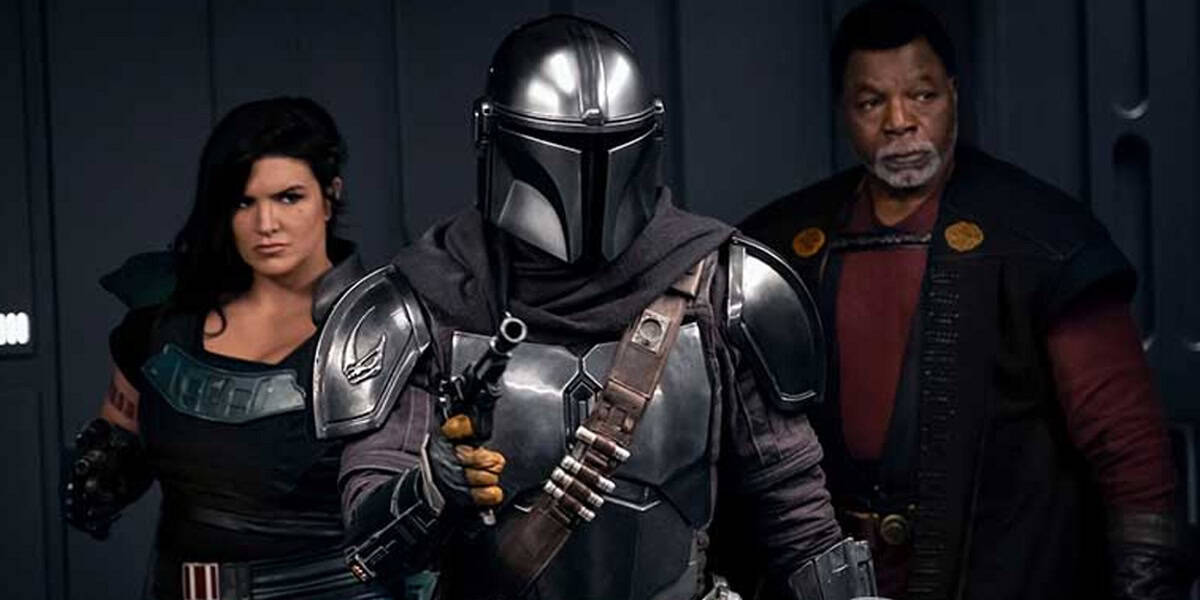
That evolution significantly changes the story’s dramatic texture. A bounty hunter can be unpredictable, morally flexible, and constantly at odds with everyone around him. A sanctioned operative working for the New Republic follows a clearer path, one that aligns more closely with traditional Star Wars hero narratives. The trade-off is familiarity replacing the tension that once set the series apart.
The shift also reframes Din’s emotional journey. His transformation into a reluctant father figure resonated because it unfolded without forcing him into heroism. Now, with Din fully committing to the “good guys,” his arc reaches a conclusion that some viewers may see as earned growth, while others may interpret it as a loss of the character’s original appeal.

Grogu’s Abilities Take a Dramatic Turn
Din isn’t the only character undergoing a redefinition. A leaked synopsis suggests Grogu’s role changes in equally consequential ways. During the film, Grogu reportedly discovers an ancient artifact that amplifies his Force abilities, potentially removing many of the limitations that have defined him throughout the series.
The discovery allegedly occurs during a mission to an abandoned Imperial installation on the planet Khar’Zuun. While tracking down Imperial remnants turned warlords, Din and Grogu stumble upon the facility, where the young Force user encounters the mysterious device. Its origins remain unexplained, but its purpose is clear: it enhances Force sensitivity.

Throughout The Mandalorian, Grogu’s powers were impressive but inconsistent. He could perform feats of healing, telekinesis, and raw Force output, yet those moments often came at a physical cost. His training with Rosario Dawson’s Ahsoka Tano emphasized restraint and control rather than escalation. The artifact could change that balance entirely, allowing Grogu to access his abilities more reliably and with greater impact.
Narratively, the timing of this development suggests a functional reason. Early footage and casting information hint that Din and Grogu may spend portions of the film apart. Empowering Grogu gives him the agency to survive, and even thrive, without constant protection. Instead of remaining the vulnerable child in need of rescue, he could become an active participant in parallel storylines.

This shift also signals that The Mandalorian and Grogu is designed as a turning point rather than an extended episode. The introduction of a Force-enhancing artifact creates a clear dividing line in Grogu’s journey, positioning the film as a before-and-after moment for the character.
The fact that the artifact is reportedly located in an Imperial facility raises broader questions. Did the Empire study Force amplification? Was this device part of a forgotten weapons program, or something the Imperials never fully understood? Whatever the answer, its existence ties Grogu’s evolution to deeper layers of Star Wars lore.

Cinematic Storytelling Versus Serialized Television
When Lucasfilm announced the project as a theatrical release instead of a fourth Disney+ season, skepticism followed. Many assumed the film would simply function as a longer episode with upgraded visuals. Favreau has pushed back against that idea, emphasizing that the movie was conceived specifically for cinemas.
Favreau confirmed that scripts for a potential fourth season were already written and remain separate from the film’s development.
“We were planning on doing a fourth season,” Favreau said. “I had actually written all of that. I still have Season 4 sitting on my desk here.”

Television allowed The Mandalorian to unfold gradually, with character arcs and subplots stretched across weeks. Early seasons leaned heavily on episodic adventures that advanced larger narratives in small increments, a rhythm well-suited to streaming audiences.
Film demands a different approach. A single, self-contained story requires tighter pacing, clearer stakes, and more immediate payoffs. Favreau has indicated that The Mandalorian and Grogu embraces this structure, aiming for a scope that wouldn’t fit comfortably within episodic television.

This structural shift affects the supporting cast as well. Characters like Bo-Katan Kryze and the Armorer benefited from recurring television appearances. A theatrical runtime forces tougher decisions about who appears and how much development they receive, which may explain the absence of several familiar faces.
The larger canvas also allows for more expansive action. Reports of a gladiator arena sequence suggest Lucasfilm is leaning into set pieces designed explicitly for theatrical impact, offering spectacle that differentiates the film from its streaming predecessor.

Rotta the Hutt Enters the Spotlight
One of the film’s most unexpected elements is Jeremy Allen White’s role as Rotta the Hutt, the grown son of Jabba. Early indications suggest Rotta may share significant screen time with Din Djarin, potentially replacing Grogu as Din’s primary companion for much of the movie.
White fueled speculation during a television appearance when he mentioned that his character and Din would be “running around for a lot of the movie together.” The comment implies an extended partnership rather than a brief encounter.

This represents a sharp departure from the series’ emotional core. The bond between Din and Grogu anchored The Mandalorian, grounding its adventures in a deeply personal relationship. Shifting that focus to Din and Rotta redefines the story’s dynamic.
Promotional materials reinforce this idea, frequently showing Din and Grogu in separate sequences. While Grogu remains present, he isn’t consistently positioned alongside Din, suggesting parallel narratives that intersect selectively.

Rotta’s inclusion brings rich narrative potential. Introduced as an infant in 2008’s Star Wars: The Clone Wars, Rotta now stands as an heir to Jabba’s criminal legacy. In a galaxy struggling to rebuild, his position within the Hutt syndicate places him at the center of shifting power dynamics. Din’s alignment with the New Republic could require uneasy alliances, including working alongside figures tied to organized crime.
The gladiator arena scenes hinted at in early footage suggest Rotta plays an active role in the film’s conflicts. Whether as a combatant, captive, or strategist, his presence appears far more substantial than a cameo.
Fan theories range from rescue missions to political bargains to internal Hutt power struggles. Rotta may even be seeking a path separate from his father’s shadow, complicating Din’s understanding of justice and loyalty.
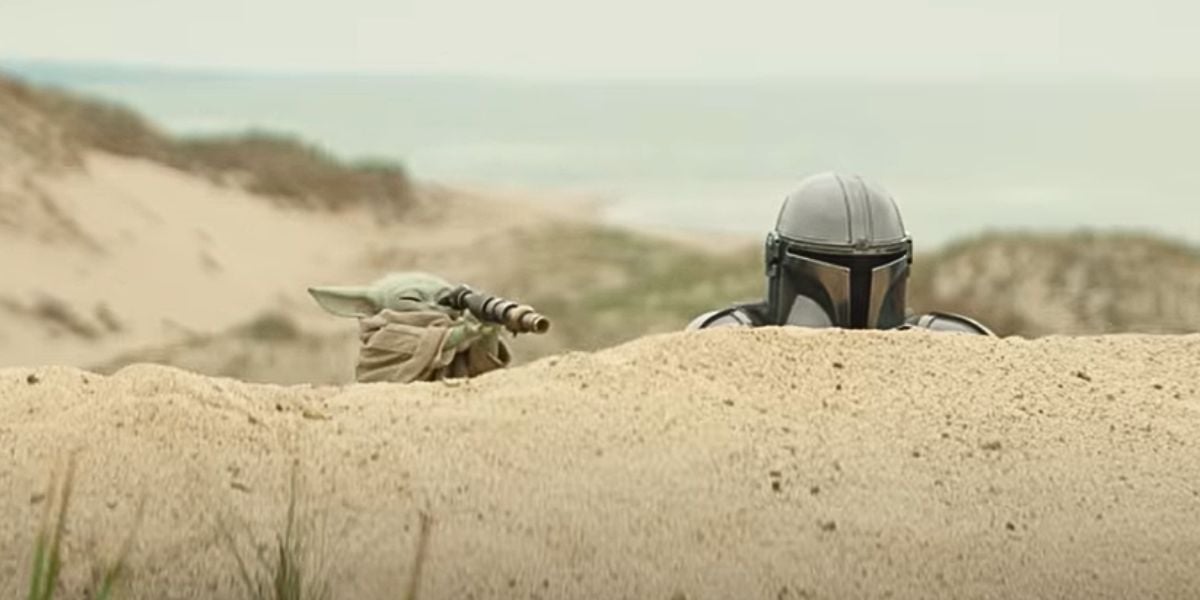
If Din spends much of the film with Rotta, Grogu’s journey must stand on its own. The Force-amplifying artifact could facilitate that independence, allowing both characters to evolve separately before reuniting. Din’s time with Rotta may test his commitment to the New Republic, while Grogu’s newfound strength could redefine his place in the galaxy.
The approach carries inherent risk. Audiences invested in the Din-Grogu relationship may resist extended separation, while others may welcome the expansion. The film’s success will hinge on whether these choices feel purposeful rather than disruptive.

A Pivotal Moment for Star Wars on the Big Screen
The Mandalorian and Grogu arrives as Lucasfilm’s first theatrical Star Wars release in seven years, carrying the weight of bridging streaming success with cinematic revival. The film doesn’t aim to preserve the status quo. Instead, it reshapes its characters, its tone, and its narrative ambitions.
Din’s transition from neutral bounty hunter to New Republic operative, Grogu’s amplified abilities, and the introduction of Rotta the Hutt all signal a willingness to redefine what this corner of Star Wars looks like. For some, these changes represent logical character growth. For others, they risk erasing the elements that made The Mandalorian distinctive.

Both perspectives are valid, and the film’s reception will depend on execution. Can a Mandalorian working for the New Republic retain complexity? Can a more powerful Grogu remain emotionally resonant? Can Rotta justify his expanded role?
Those answers arrive on May 22, 2026. Whether embraced or debated, The Mandalorian and Grogu is positioned as a statement about Star Wars’ future—one where familiar characters step into unfamiliar roles as the franchise returns to theaters.
The Mandalorian and Grogu stars Pedro Pascal as Din Djarin, Sigourney Weaver as Admiral Ward, Jeremy Allen White as Rotta the Hutt, Jonny Coyne as an Imperial Warlord, Dave Filoni as Trapper Wolf, and Steven Blum as Garazeb “Zeb” Orrelios.
How do you feel about all these departures from The Mandalorian TV series? Do you think it is a good sign, or too much of a change? Let us know in the comments down below!





Nothing in the initial trailer suggests they will be “apart” although season 3 ended with them being briefly separated, something that would be a natural progression given before it was stay or come and now if he has an artifact that enhances his ability, working separately on a common problem makes sense in how Mandalorian’s think.