Walt Disney Imagineering is built on a foundation of boundless ambition. The core philosophy of EPCOT, in particular, has always been to push the envelope of technology, architecture, and storytelling. However, theme parks are not just conceptual art installations; they are heavily trafficked, real-world environments subject to the brutal forces of nature and millions of footsteps. Sometimes, no matter how beautiful an idea looks on a blueprint, physics and weather simply refuse to cooperate.
If you visit EPCOT today, you will witness the sobering aftermath of one of these conceptual battles. In a move that is both highly surprising and deeply inevitable, Disney has officially begun ripping out the programmable in-ground LED lighting system in World Celebration Gardens. After nearly three years of malfunctions, embarrassing temporary fixes, and genuine safety hazards, the glowing EPCOT logo is no more. Instead, construction crews are filling the empty trenches with plain, gray concrete.
To understand how a marquee feature of EPCOT’s historic, multi-year transformation ended up buried under a sidewalk, we have to trace the timeline of a luminous dream that quickly turned into an operational nightmare.
A Luminous Dream That Quickly Faded
When the construction walls finally came down around World Celebration Gardens in December 2023, the central plaza was heralded as the park’s kinetic new heart. With the iconic Fountain of Nations long gone, this new courtyard was designed to serve as a dynamic gathering space.

The crowning achievement of this area was meant to be the sprawling, state-of-the-art in-ground LED lighting system. Thousands of fixtures were embedded in the pavement, forming a massive, brilliant version of the classic EPCOT logo. The conceptual vision was undeniably stunning: at night, the pavement was programmed to synchronize seamlessly with the dazzling “Points of Light” shows on Spaceship Earth, the exterior lighting of CommuniCore Hall, and the glowing interior of Connections Cafe.
Unfortunately, the reality of theme park operations set in almost immediately. Within months of the grand opening, the system began to fail. Sections of the intricate logo went completely dark. Other strips glitched, displaying incorrect colors that broke the carefully choreographed synchronization. But electrical gremlins were only the beginning of the problem.
Florida Heat and Major Tripping Hazards
Walt Disney World operates in a notoriously unforgiving climate. The combination of relentless Florida UV rays, torrential afternoon downpours, and the stomping shoes of thousands of daily guests requires park infrastructure to be practically indestructible. The new LED lighting strips, protected by translucent plastic covers, were simply not up to the task.

As EPCOT entered the sweltering heat of its first summer in 2024, the plastic covers began to degrade rapidly. The intense thermal expansion caused the plastic to warp, lift, and eventually crack. The connecting joints where each light strip met the next began to rise significantly above the pavement line.
Almost overnight, the multi-million-dollar lighting feature transformed into a massive, sprawling tripping hazard. The environment exacerbated the danger guests naturally face as they walk through World Celebration Gardens at night, with their eyes turned upward to admire Spaceship Earth. The last thing they expect is to catch their shoe on a jagged piece of lifting plastic. To mitigate the danger, Disney was forced to surround large portions of the brand-new courtyard with temporary stanchions and planters, blocking off the very area they had just spent half a decade building.
The Infamous “Dad Fix” of 2025
By the summer of 2025, the situation had escalated from an aesthetic disappointment to a logistical embarrassment. With the area partially barricaded and the plastic strips continuing to buckle, Walt Disney Imagineering needed an immediate, physical solution. The fix they ultimately deployed left the Disney fandom completely baffled.

In June 2025, maintenance crews resorted to what can only be described as a desperate “Dad fix.” Workers took standard decking screws and literally drilled them directly through the plastic lighting covers and into the concrete below to pin the warping strips down. Some sections received one screw on the edge; others were held together by multiple screws driven in at haphazard angles.
In a frantic attempt to camouflage the hardware, the tops of the screws were dabbed with white paint, which began chipping off almost as soon as it dried. To fill the uneven gaps created by the warped plastic, thick yellow caulking was smeared along the edges. It was an incredibly jarring, inelegant solution for a company renowned for its unparalleled attention to detail. It served as a stark visual reminder that the centerpiece of EPCOT’s redesign was fundamentally broken.
Waving the White Flag: Enter the Concrete
Fast forward to August 2026. After years of battling broken LEDs, warped plastic, and the public embarrassment of the deck-screw fix, Disney has seemingly waved the white flag.

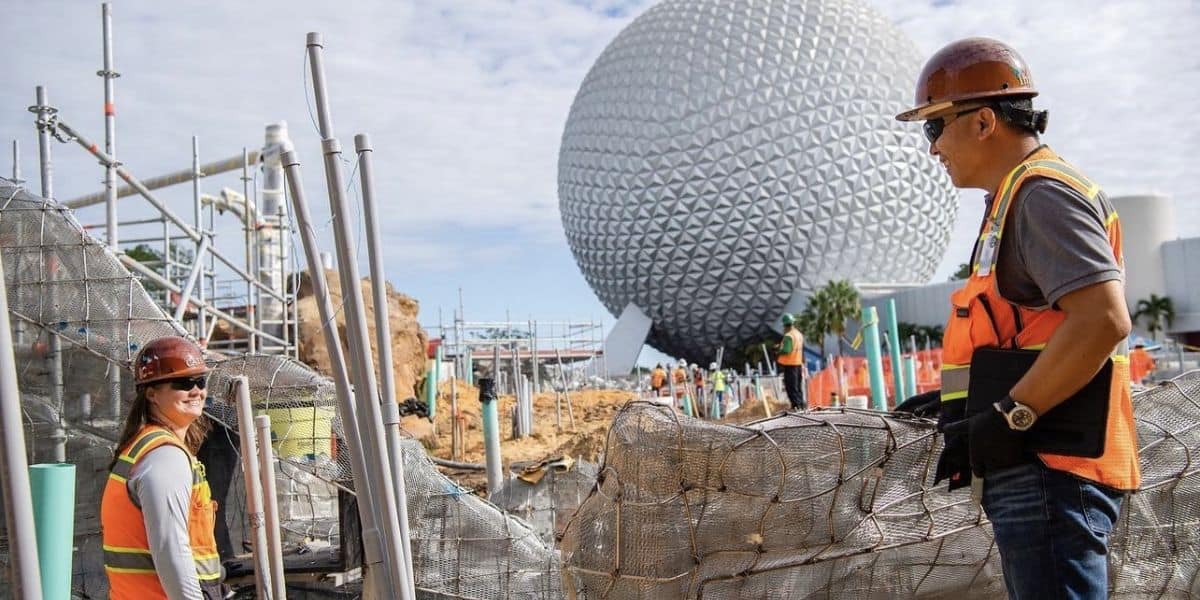
Earlier this month, construction walls went back up around half of the central courtyard. Guests looking past the barriers noticed that the screwed-down light strips were actively being ripped out of the ground, leaving empty, dirt-filled trenches in the shape of the EPCOT logo. Any lingering hope that Disney was preparing to install a durable, upgraded version of the lights was dashed this week when crews began pouring plain, unlit concrete into the voids.
Paving over the trenches is a brutal dose of reality. While it is always disappointing to see a piece of theme park magic disappear, guest safety and operational reliability must take precedence. A flat, unremarkable sidewalk is vastly superior to a broken, glitchy trip hazard held together with hardware-store screws. Disney recognized it was a lost cause and made the tough call to bury it literally.
The Nostalgic Irony of the Original Future World
What makes this concrete defeat particularly bitter for longtime EPCOT fans is the historical irony. Before the World Celebration overhaul, the original Future World featured its own iconic in-ground lighting.

The legacy pavement lights in the old Innoventions plaza—which used older fiber-optic technology—sparkled reliably on the concrete for years. They were completely flush with the ground, highly durable, and deeply beloved by guests. Disney ripped out a perfectly functioning, nostalgic lighting system to replace it with a modernized LED version that couldn’t survive a single Florida summer.
Theme park design is an iterative process, and pushing the boundaries of technology guarantees that some experiments will fail. EPCOT’s new concrete pathways may lack the intended synchronized magic, but they finally offer guests a safe place to walk. Sometimes, the most functional thing a sidewalk can do is just be a sidewalk.
Do you think Disney made the right call by paving over the lights, or should they have invested in a completely different technological solution?