Universal Orlando Is Erasing One of Islands of Adventure’s Last Original Worlds
A Dining Experience Is All That Remains (for Now)

For theme park fans, some places become more than pathways between rides. They become memories. They become childhood photos, first vacations, favorite restaurants, strange hidden corners, and the kind of immersive details guests do not fully appreciate until they start disappearing.
At Universal Orlando Resort, few areas carry that kind of quiet emotional weight quite like The Lost Continent. For years, the land stood as one of Islands of Adventure’s most unusual creations: not tied to a current blockbuster franchise, not built around a single movie, and not designed to sell one obvious intellectual property. It was mythology, mystery, ancient temples, talking fountains, fire, water, gods, monsters, and medieval adventure all wrapped into one.
Fans are noticing that something has shifted. What once felt like a fully realized world has slowly become a shell of what it used to be. Guests still walked past the towering rockwork, the Mystic Fountain, and Mythos Restaurant, but the energy around the land had changed. Now, that slow transformation appears to be entering its most dramatic chapter yet.
Why Does This Universal Orlando Change Feel So Personal for Fans?
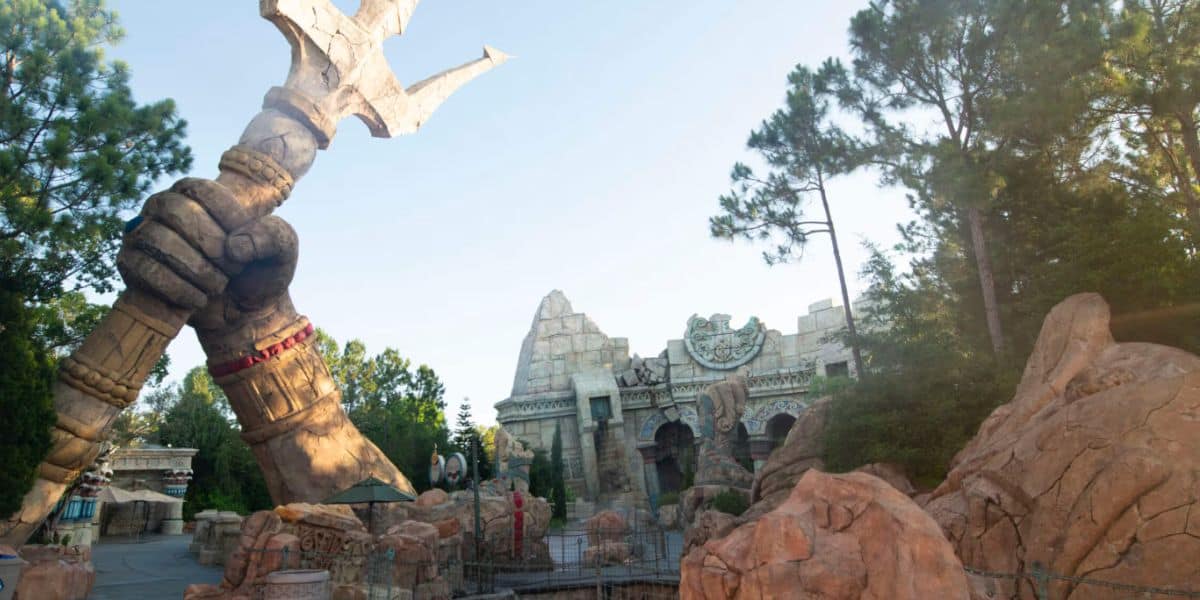
New footage and construction updates show demolition work moving forward inside The Lost Continent at Universal’s Islands of Adventure, including activity around the former Eighth Voyage of Sindbad theater. Construction walls have also expanded near Poseidon’s Fury, signaling that Universal is no longer simply leaving these long-closed spaces untouched. The land is being actively prepared for what comes next.
That matters because The Lost Continent was not just another themed area. It opened with Islands of Adventure in 1999, helping define the park’s original identity alongside Marvel Super Hero Island, Jurassic Park, Seuss Landing, Toon Lagoon, and Port of Entry. Unlike the franchise-heavy additions that would later reshape Universal Orlando, The Lost Continent felt like an original fantasy realm built for exploration.
For longtime guests, seeing pieces of it come down feels like watching another chapter of early Islands of Adventure history fade away. A surprising change like this hits differently because it is not just about losing empty buildings. It is about losing the atmosphere that once made the park feel experimental, strange, and bold.
What Made The Lost Continent Such a Big Part of Islands of Adventure History?
When Islands of Adventure opened on May 28, 1999, The Lost Continent was one of the park’s most ambitious lands. It featured Dueling Dragons, the high-speed twin inverted coaster later reworked and eventually removed; Poseidon’s Fury, an effects-heavy walk-through attraction; and The Eighth Voyage of Sindbad, a live-action stunt show that blended comedy, combat, and old-school theme park spectacle.
Aerial video of demolition in progress in The Lost Continent. At both the Sinbad theater and Poseidon’s Fury. – @bioreconstruct on X
Aerial video of demolition in progress in The Lost Continent. At both the Sinbad theater and Poseidon's Fury. pic.twitter.com/IwOl7hhe7t
— bioreconstruct (@bioreconstruct) May 2, 2026
The area also became known for Mythos Restaurant, which remains one of Universal Orlando’s most visually striking dining locations, and the Mystic Fountain, an interactive feature that turned a simple walk through the land into a memorable guest encounter. For many visitors, these smaller details were what made The Lost Continent feel alive.
Aerial photos of demolition in front of the former Poseidon’s Fury in The Lost Continent.
Aerial photos of demolition in front of the former Poseidon's Fury in The Lost Continent. pic.twitter.com/6xEBxQJioK
— bioreconstruct (@bioreconstruct) May 2, 2026
But over time, the land began to shrink. Dueling Dragons became Dragon Challenge before closing to make way for Hagrid’s Magical Creatures Motorbike Adventure. The Eighth Voyage of Sindbad ended its run in 2018. Poseidon’s Fury permanently closed in May 2023 after previously reopening in 2022 following a lengthy closure.

Why Are Guests Already Reacting to the Demolition?
Guests are already reacting because this feels final. A closed attraction can always inspire hope. Fans can imagine a refurbishment, a surprise reopening, or a nostalgic comeback. Demolition removes that possibility.
Aerial photo of demolition in front of the former Poseidon’s Fury in The Lost Continent.
Aerial photo of demolition in front of the former Poseidon's Fury in The Lost Continent. pic.twitter.com/eYdIqMslMA
— bioreconstruct (@bioreconstruct) May 2, 2026
The former Sindbad theater had sat abandoned for years, but its physical presence still reminded fans of what the land used to be. Poseidon’s Fury, with its massive temple façade, remained one of the most recognizable structures in Islands of Adventure even after its closure. As walls expand and work continues, the message feels clear: Universal is preparing this space for a new future.
That future has not been officially announced. Universal has confirmed construction activity in the area as part of site planning for future development, but the company has not revealed what will replace The Lost Continent.
That silence is fueling speculation. Fans are filling the gap with theories, and right now, Nintendo is at the center of the conversation.

Could Pokémon or Zelda Replace The Lost Continent?
Based on recent rumors and permit activity, two names keep surfacing among Universal fans: Pokémon and The Legend of Zelda. Both would make sense in different ways, especially as Universal continues expanding its relationship with Nintendo across its theme park portfolio.
A Pokémon land would give Islands of Adventure a family-friendly, globally recognized franchise with massive merchandise potential. Some rumors have suggested a dark ride concept involving Poké Ball-style interactive gameplay, which could give Universal a major all-ages attraction in a park already known for thrill-heavy experiences.
The Legend of Zelda may be the more natural thematic fit for The Lost Continent. Hyrule, temples, ruins, water, forests, castles, and mythical creatures could slide into the emotional footprint of the current land without feeling completely disconnected from what came before. Industry observers have noted that Zelda and Pokémon remain two of the most discussed Nintendo possibilities, though Universal has not confirmed either one for this site.
Other rumored possibilities have included Wicked, Lord of the Rings, and even One Piece, but Nintendo appears to be the strongest fan-facing theory right now. Still, until Universal makes an official announcement, everything beyond demolition and site preparation remains speculation.

What Could This Mean for Universal Orlando Guests Going Forward?
For guests, the immediate impact may be construction walls, altered pathways, changing sightlines, and the emotional reality of seeing a once-iconic land disappear piece by piece. For future visitors, however, this could mark the beginning of one of the most important redevelopments in Islands of Adventure history.
Universal Orlando is entering a new era. Epic Universe has already changed the resort’s long-term momentum, and now Islands of Adventure appears ready for its own major refresh. If The Lost Continent becomes a major Nintendo expansion, Universal could create another powerful reason for guests to visit multiple parks instead of treating Epic Universe as the only must-see destination.
But for longtime fans, excitement comes with a little heartbreak. The Lost Continent represented a version of Universal that was willing to build an original mythological world from scratch. Whatever replaces it may be bigger, more marketable, and more technologically advanced.
Still, as the walls rise and the old structures come down, one thing feels certain: Universal Orlando is not simply removing a closed attraction. It is closing the book on one of Islands of Adventure’s original worlds, and guests are watching closely to see what rises from the ruins.