
We talk a lot about food here. Festival booths, quick service hidden gems, the best place to grab a snack before rope drop.
That is our whole thing.
But every now and then something happens in the Disney world that is bigger than what is on the menu, and this is one of those moments. Because while we were busy debating whether the new EPCOT festival booth was worth the wait, Disney’s annual shareholder meeting on March 18 got genuinely tense.
New CEO Josh D’Amaro was asked directly about the Disability Access Service program — the accessibility tool that for many families with disabilities is not a nice-to-have, it is the entire reason a Disney vacation is possible at all. The program has been controversial since Disney overhauled it in 2024, and the fallout has never fully quieted down. Shareholders voted on a formal proposal about it. D’Amaro had to answer for it on the record. And the outcome of that meeting tells you a lot about where Disney stands right now on one of the most significant guest experience debates the company has faced in years. We broke it all down.
So What Actually Is DAS and Why Is Everyone Upset

Quick background for anyone who needs it, because this matters.
The Disability Access Service lets guests who cannot tolerate extended waits in a conventional queue book return times for attractions through the My Disney Experience or Disneyland app. Instead of standing in a standby line for an hour, they can go shop, eat, or ride something with a shorter wait, then come back during their window. For guests with disabilities that make long queue waits genuinely impossible, this is not a perk. It is what makes the park accessible.
In 2024, Disney significantly tightened who qualifies. The updated criteria limited DAS to guests with a “developmental disability like autism or similar” who cannot wait in conventional queues. That language knocked out a large portion of guests with physical disabilities who had previously relied on the program.
Disney’s reasoning was not entirely without merit. When the company replaced free FastPasses with the paid Lightning Lane system — which can run over $100 per day for a family of four on top of park tickets — DAS became a lot more attractive to people who were not necessarily using it in good faith. Abuse of the program was a documented problem. But the way the crackdown played out left a lot of people feeling like they were being punished for other people’s behavior.
Reports came out of cast members telling denied guests to practice waiting in line at home. To rent wheelchairs. To re-enter a queue by finding a family member already waiting — a suggestion that is logistically messy in a packed theme park and completely useless for solo visitors. Not a great look.
Disney has tweaked things since then, extending the validity period and clarifying the video call process with third-party medical reviewers. But the core eligibility restrictions? Still in place.
What D’Amaro Actually Said on the Record
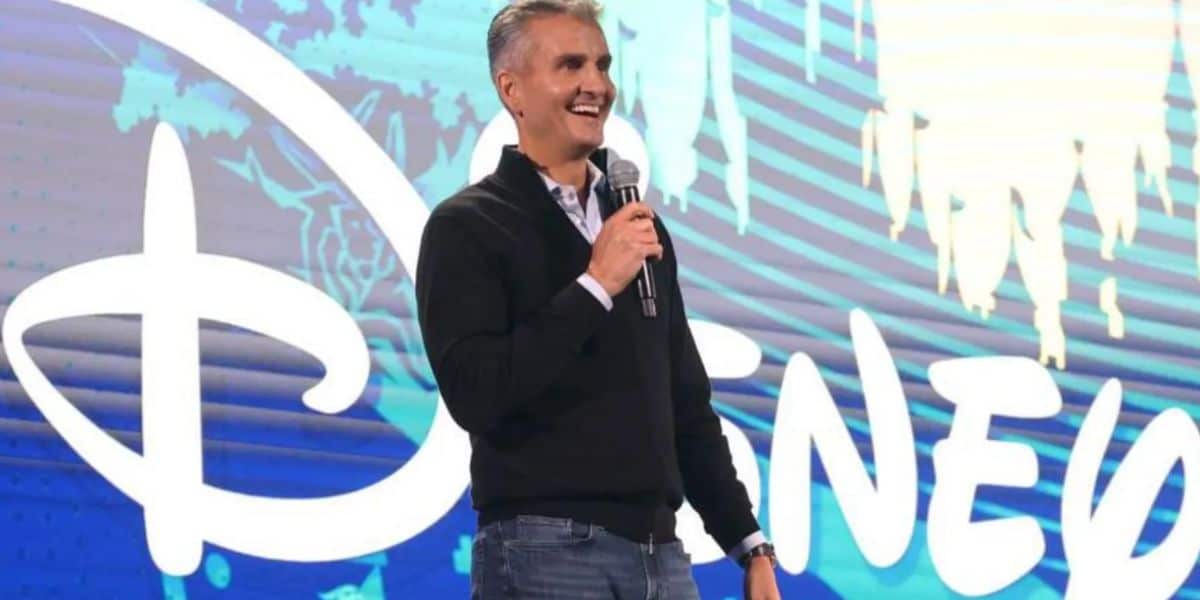
Near the end of the shareholder meeting, someone asked whether Disney would consider restructuring DAS to make sure it actually reaches everyone who needs it. It was a direct question. D’Amaro gave a carefully worded answer.
He started with the human stakes: “Accessibility is deeply personal and for many families, our services for guests with disabilities, they make it possible to enjoy our parks together.” He followed up with: “Creating a welcoming and inclusive environment for all guests, especially those with disabilities — it’s foundational to who we are.”
On the current program, he defended it: “It reflects really extensive work that we’ve done with accessibility experts and medical professionals, all in an effort to better understand individual needs and then really thoughtfully match guests with the right levels of support.”
He also pushed the individual conversation angle: “It’s important to us that we have individual conversations with families, and that we have a broad range of accommodations that our cast members can recommend through these individual conversations.”
And then he left the door cracked just slightly: “As we look ahead, as we always do, we’ll continue to listen, we’ll learn and apply expert guidance as we evaluate these accommodations over time, and we’ll always be focused on providing great experiences and designing these services to support our guests.”
Here is the part worth paying attention to. D’Amaro was the Chairperson of Disney Experiences when these changes were made. This is not a new CEO stepping into a mess someone else left behind. He built this policy. He is now defending it as CEO. That context matters.
The Shareholder Proposal That Got Voted Down
Disney shareholder Erik Paul pushed back formally with something called Proposal 7, officially titled “Review and Report on Disability Inclusion and Accessibility.” It asked Disney to bring in an independent third-party investigator to look at the DAS changes through the lens of legal, financial, reputational, and enterprise risk, then report the findings to shareholders. It did not demand Disney change a single thing. It just asked for transparency about the risks.
Paul’s argument was direct: “Accessibility policies influence brand trust, customer loyalty, regulatory exposure, guest safety, and repeat visitation. When policies are misaligned or inconsistently implemented, the resulting impact extends beyond guest experience to operational and reputational risk.”
Disney initially tried to get the SEC to let them exclude the resolution entirely, calling it “materially false and misleading.” A policy shift at the SEC made that unnecessary, and the vote went ahead — with Disney actively telling shareholders to vote no.
They did. By a lot. About five percent of shareholders voted yes on Proposal 7. It was not close.
And yes, there is an active class-action lawsuit filed in 2025 by a Disneyland guest over the DAS changes. That one is still working through the courts.
What This Means If You Have a Disney Trip Coming Up
If your family relies on DAS, nothing changed on March 18. The 2024 eligibility requirements are still in effect. You still need to qualify based on a developmental disability, complete a video call with a third-party medical reviewer, and reapply every twelve months.
D’Amaro’s “we will continue to listen” language is not nothing, but it is also not a promise. If someone in your group was eligible under the old DAS criteria and no longer qualifies, the most useful thing you can do before your trip is contact Disney’s accessibility services directly. D’Amaro mentioned that cast members can walk families through a broader range of accommodations in individual conversations, and that process exists regardless of DAS eligibility.
If the current program does cover your needs, it works as advertised. And if you are watching this situation from the outside, the lawsuit and D’Amaro’s stated openness to evaluation are the two things worth monitoring as 2026 moves forward.
We will be watching both. Obviously. That is also kind of our thing.
We will keep updating as the class-action lawsuit moves forward and as any new DAS guidance drops. In the meantime, if you are planning a Disney trip and working through accessibility questions, our full Disney Parks planning guide is on the site and covers everything currently available for guests who need accommodation support. Go read it, then come find us when you are ready to talk about what to eat.



Instead of being mad at Disney, be mad at the losers that abused the system that forced Disney to make changes. I know personal responsibility is hard for a ton of people, but put blame where it belongs.
You can be mad at both. Yes, Disney did make changes because of those abusing it, but it is so rigid, their recommendation to me was to rent a wheelchair and let my daughter push me around and wait in line or wait with her…those were the two options I was given. I used it before and always waited by the ride until my time was up.
It’s hard for 100% disabled Veterans to figure out how to maneuver through the rides/ parks without help and guidance. You’re told to go through the regular line, but when you do, then it’s oh no, you need to go out of this line and go around to another place, or another door, and then go wait there. 1st they are told you do not get any help, It’s mainly for children or whatever other terms they use. (After making you over share about your disability and medical history, & then discounted). When you do go to the other door, other line etc. and a Disney person helps you get to the right place, that person asks all types of questions, the disabled person answers all the questions, then you get up to the ride, then another person asks you the same questions, this time making the disabled person feel pressured to answer a different way, (Can’t you do this? Can’t you do that?). It’s awful. Really Disney, get it together. If the disabled person gets no accommodation, please don’t make them feel worse by highlighting their problems and asking them over and over until you get the answer you want. And clearly mark or have a Disney employee trained that knows Disabled Veterans and their unique problems to help guide them where they should go and what to do on a particular ride. And don’t ask them 2, 3 times the same questions over and over until they feel bullied to do what you want. And then if they do what you want they are Physically and mentally done for the day! Disney has no clue.
I think we should get a class action law suit against Disney. By saying disabled people are not disabled should be against the law.
We agree with Deb…..a person is either disabled or not and the mere title of the DAS Disability Access Service is surely first degree DISCRIMINATION and if it does not apply to ALL disabled people then the title of the programme needs to be changed .
Both my wife and myself are registered as Disabled in the UK .. but not recognized as being disabled in Disney.
My wife’s UK consultant even wrote a letter to support her case….but the video call was somewhat patronizing and just refused to even read the letter !
How qualified are these video decision makers to take such decisions ?
We agree that the previous system was grossly abused……but why should genuine disabled folks suffer ?
Not at all happy ??
Personally if I was disabled, the Disney parks would be the last place I’d want to go.
I agree and Disney parks have lost my family attendance as I noticed the difference over ( confused by different Stage members,etc) the last 30 years as to where to go as I wheel my wife through DisneyLand – I can imagine the headache of DisneyWorld, which we last visited in the 1990’s as Fast Track $$ line was introduced — Disney will NOT SEE my family walking through their parks – my childhood memories are being erased so they aren’t getting any $$ from us!
I want to be a part of that class action suit. I needed that perk. Without it on our last trip I nearly lost it on a person in line. 100% out of my control. Had my husband not walked me away, there’d be a different conversation going on now.
As a 100% disabled veteran who had a annual pass and disability pass for over 30 years I let my pass expire because I went to the parks just after the change and the treatment I received was horrible I ended up having to buy the lighting lane or end up not going I spent an average of 15 to 20k every visit between meal, hotels and souvenirs I have since changed to universal and will not return till changes are made universal had no issues with disability access