For over seven decades, the core foundation of the Disney theme park empire has not been its roller coasters, fireworks, or fairy-tale castles, but its human workforce. Known throughout the industry as Cast Members, these workers—from parking attendants greeting visitors at sunrise to backstage crews keeping rides spinning until midnight—have provided the emotional core and high-touch hospitality that separates Disney from its regional amusement competitors.
Now, an aggressive technological pivot is quietly reshaping that reality.
At the 2026 Disney Accelerator Demo Day in Burbank, Walt Disney Imagineering and Disney Experiences Technology pulled back the curtain on advanced robotics and artificial intelligence initiatives. Rather than showcasing scripted animatronics or fantasy illusions, the presentations focused on physical tasks traditionally handled by entry-level workers. Behind closed doors, autonomous AI units inspired by Pixar’s Cars and Wall-E have been trialed directing traffic in multi-story parking structures. At the same time, dexterous robotic arms are being trained to clean, untangle, and sort 3D glasses backstage.
While company executives frame these emerging systems as ergonomic assistants designed to free employees from repetitive physical tasks, the timing of their introduction has sparked fierce debate. Amid recurring corporate layoffs and intensifying rumors of further budget cuts targeting thousands of administrative and operational roles, theme park employees are asking whether Disney is building an autonomous workforce destined to make their jobs obsolete.
Directing Traffic: AI ‘Cars’ in the Parking Garages
The most public-facing experiment unveiled by Disney involves FieldAI, an Irvine-based robotics company that has spent months collaborating directly with Walt Disney Imagineering R&D and Disney Experiences Technology.
During the Burbank demonstrations, Disney shared footage of an experimental mobile robot designed in the aesthetic of Pixar’s Cars—outfitted with character styling, an on-board instruction display, and illuminated, traffic-control-style arms. Rather than rolling through controlled indoor laboratory tracks, the robot was tested navigating dynamic real-world environments, pointing human drivers into open stalls and guiding vehicular traffic through Disneyland’s parking complexes, such as the massive Mickey & Friends and Pixar Pals garages.
FieldAI’s physical AI platform equips mobile machines to operate autonomously in unstructured, dynamic environments without requiring fixed magnetic floor tracks. Using integrated computer vision and dynamic sensor arrays as real-time “eyes and ears,” the robot identifies vehicles, pedestrians, uneven ground, and lighting shifts on the fly.

Framing the trial around brand storytelling, Gary Daniels, Senior Vice President of Products and Experiences at Disney Experiences Technology & Digital, highlighted the project’s interactive ambitions:
“Imagine if a character from Cars or robots from Wall-E direct you where to park when you arrive. The work we are doing now is a great way to see how the robots function and, as important, how people respond.”
Yet for the hundreds of human parking attendants who work in the morning chill, afternoon heat, and vehicle exhaust to choreograph tens of thousands of vehicles every weekend, the visual is jarring. Directing parking traffic has served as an essential entry-level resort position for decades. The demonstration showed that an autonomous fleet could theoretically direct traffic continuously without fatigue, meal breaks, overtime pay, or healthcare coverage.
Backstage Sorting: RobotiGrinds Tackle the 3D Glasses Grind
While FieldAI works outdoors, a concurrent collaboration targets the repetitive grind of backstage theme park operations.

Disney confirmed it is collaborating with Physical Intelligence, a robotics startup developing foundation models that teach robotic arms to manipulate physical objects using sight, touch, and spatial reasoning. The primary operational test at Disneyland: handling, untangling, and racking 3D glasses between attraction show cycles.
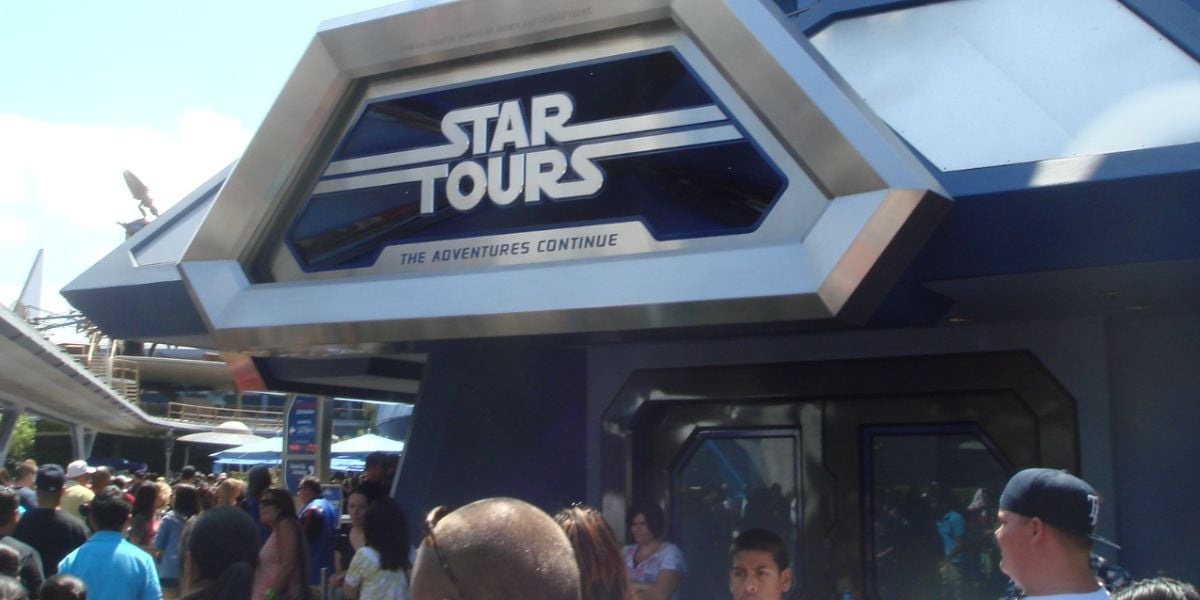
For attractions like Star Tours: The Adventures Continue, Toy Story Midway Mania!, and Millennium Falcon: Smugglers Run, managing 3D eyewear is an endless, high-volume chore:
- Collection bins filled with thousands of tangled, sweat-smeared, and smudged plastic frames must be cleared from exit ramps every hour.
- Workers must manually separate jumbled glasses, inspect them for cracks or lens scratches, and align them neatly on industrial dishwashing racks.
- Racks are rolled into high-temperature sanitizing wash tunnels, dried, and restacked into mobile dispatch bins for return to loading docks.
- Any glasses dropped onto the floor must be quickly retrieved and segregated for deep sanitization.
Victor Hwang, a member of the technical staff at Physical Intelligence, noted that sorting 3D glasses is a deceptive challenge: “It’s a pretty hard dexterous task.” The company’s models learn via human demonstrations, interpreting visual and tactile feedback to adapt when frames become twisted together.
Disney claims automating this repetitive work will free Cast Members to focus on higher-touch guest interactions. However, backstage custodial, staging, and operational support roles account for a substantial share of union-backed labor hours at the Disneyland Resort. If multi-jointed robotic arms can untangle and rack thousands of glasses an hour without human hands, dozens of operational shifts across multiple attractions could be eliminated with a software update.
Corporate Cuts and Layoff Rumors: The Backdrop of Anxiety
These robotic demonstrations arrive against an uneasy backdrop of corporate restructuring. Rank-and-file anxiety is not emerging in a vacuum; it is unfolding in the shadow of relentless cost-cutting across The Walt Disney Company.
Over the past two years, Disney has carried out several rounds of layoffs, thinning headcount across ABC, ESPN, Pixar Animation Studios, corporate divisions, and Disney Experiences. Under pressure to widen operating margins and accelerate return on capital, corporate leadership in Burbank has leaned heavily into automation and workflow consolidations.
Industry watchers and labor analysts have been rattled by recent reports that Disney leadership has directed business units to explore deep structural cost reductions, including potential operational efficiency targets of up to 20%. The creation of a centralized Chief Technology Officer role, combined with executive memos emphasizing artificial intelligence and automated operational pipelines, has intensified concerns that the next wave of job cuts will target frontline, venue-level personnel rather than just corporate management.
When employees observe working prototypes of robots directing traffic and sorting inventory in the same week that corporate efficiency mandates make headlines, warnings about job displacement become impossible to ignore.
Hospitality vs. Hardware: The Peril of Replacing Cast Members
Disney maintains that its robotics initiatives remain in early experimental phases, emphasizing that autonomous tools are intended to assist workers rather than replace them. Yet replacing human staff with automated systems introduces operational and cultural risks:

- Erosion of Genuine Hospitality: An autonomous cart cannot comfort a crying child who lost their parents, give directions to a confused first-time visitor, or make intuitive exceptions for disabled guests struggling to load. The interpersonal warmth of Cast Members has long formed the core justification for Disney’s rising ticket prices.
- Technical Vulnerabilities: Dense theme park crowds, sudden downpours, sensor blind spots, and network interruptions present hurdles for mobile robotics. If an automated parking assistant freezes or misreads an oncoming vehicle, traffic gridlock across Anaheim access roads could follow rapidly.
- Labor Union Resistance: Thousands of frontline Disneyland workers are represented by organized labor coalitions, including the Master Services Council and Workers United. Collective bargaining agreements contain stringent stipulations regarding job classifications, technological disruptions, and workplace safety. Introducing autonomous machines that threaten to eliminate union positions will trigger severe friction at the negotiating table.
The Machine-Driven Horizon
With the city of Anaheim having approved DisneylandForward—paving the way for decades of new lands, hotels, and expanded resort districts—Disney’s operational scale is set to balloon. The corporate drive to contain labor overhead while managing that future expansion makes automation an enticing balance-sheet lever.

The technology demonstrated by FieldAI and Physical Intelligence proves that machine labor inside theme parks is no longer confined to scripted show figures. Whether these robotic assistants ultimately support human employees or gradually push thousands of workers off the midway will be a defining test of Disney’s core identity in the decades ahead.