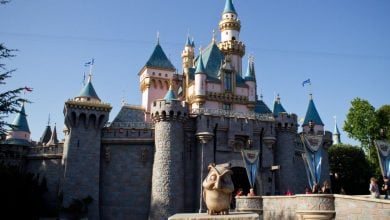
Disneyland’s 70th Anniversary is currently in full swing, and while the “Happiest Place on Earth” is busier than ever, it is also becoming stricter. As we move through the 2026 season, the “Disney uniform” has shifted: it’s no longer just Mickey ears and sensible sneakers. Today, the park is a sea of pastel-hued 40-ounce Stanley Quenchers and smartphones mounted to gimbals.

However, the intersection of high-capacity crowds and high-tech ride systems has reached a breaking point. To preserve both guest safety and ride reliability, Disney has officially begun a major crackdown. Effective immediately, cell phones and oversized insulated tumblers are now prohibited on several high-profile attractions, with Mickey & Minnie’s Runaway Railroad and the Incredicoaster serving as the primary enforcement zones.
Here is the breakdown of why your favorite accessories are being sidelined and how to navigate the 2026 “No-Carry” rules.
The Science of the Ban: Physics vs. The Gram
Disney’s decision isn’t about being “anti-vlogger” or “anti-hydration”—it’s a response to the cold, hard physics of modern theme park operations. In the last year, Disneyland saw a record-breaking number of “unplanned downtimes” caused by loose articles falling into ride paths.

The Projectile Problem (The Incredicoaster)
On high-velocity attractions like the Incredicoaster, a handheld object is a massive liability. At peak speeds of 55 mph and during the ride’s signature 360-degree loop, a 7-ounce smartphone becomes a dangerous projectile.
A 40-ounce Stanley cup—which can weigh nearly five pounds when full of ice and water—poses an even greater threat. If these items are dropped during the launch or the loop, they don’t just break; they can strike guests in trailing vehicles or damage the ride’s intricate magnetic braking and launch systems.
The Sensor Crisis (Runaway Railroad)
On the other end of the spectrum is Mickey & Minnie’s Runaway Railroad. While this ride doesn’t feature inversions, it uses state-of-the-art trackless technology. These vehicles navigate using a combination of LiDAR sensors, Wi-Fi, and floor-based guidance systems.

- Obstacle Detection: A dropped phone can be detected as an “obstacle” by the vehicle’s sensors, triggering an immediate emergency stop (E-Stop) for the entire room.
- Liquid Interference: Oversized tumblers like Stanley’s are prone to leaking when tipped over. A large spill of water or soda on the ride floor can interfere with the magnetic guidance strips or fry the under-car electronics.
The “Restricted List”: Where the Rules Apply
While you are still free to vlog your walk down Main Street, U.S.A., and carry your tumbler through the park, the following rides have implemented a “No-Handheld/No-Tumbler” policy at the boarding platform.

| Attraction | Phone Policy | Stanley/Large Tumbler Policy |
| Incredicoaster | Must be stowed in a bag/pouch | Strictly Prohibited |
| Mickey & Minnie’s Runaway Railroad | Must be stowed in bag/pouch | Strictly Prohibited |
| Space Mountain | Fully Stowed (No Handheld) | Prohibited on Ride |
| Star Wars: Rise of the Resistance | No Handheld Filming | Must be Stowed in Bag |
| Guardians of the Galaxy: Mission: BREAKOUT! | Secure in Pouch | Prohibited on Ride |
The Operational “Butterfly Effect”
When a guest drops a phone or spills a cup on a ride like Runaway Railroad, the consequences ripple through the entire park.

- The E-Stop: The ride system automatically shuts down for safety.
- The Manual Reset: In 2026, resetting a trackless ride can take up to 90 minutes, as every vehicle must be re-synced to the master computer.
- The Wait-Time Surge: A 90-minute closure of a headliner ride pushes thousands of guests into other lines, ballooning wait times across the entire park.
By banning these items on specific attractions, Disney is attempting to eliminate the leading cause of “preventable” ride closures during the busy 70th Anniversary season.
The “Main Character” Code of Conduct
This crackdown is also part of a larger effort to address “Main Character Syndrome” in the parks. The 2026 Disneyland Guest Code of Conduct has been updated to specifically mention that “the use of handheld recording devices on high-kinetic attractions is prohibited.”

Disney is encouraging guests to “live in the moment” rather than through a viewfinder. By enforcing these rules on Runaway Railroad and the Incredicoaster, they are ensuring that the “magic” remains immersive for everyone, rather than being interrupted by the glow of a screen or the clatter of a dropped metal bottle.
Conclusion: Safety Over Style
At the end of the day, Disneyland is a complex machine—and in 2026, it is a crowded one. As we celebrate 70 years of Walt’s dream, these new rules serve as a reminder that the safety of the “show” is the top priority.

By stowing your phone and properly managing your Stanley Cup, you aren’t just following a rule; you are helping to keep the lines moving and the rides running for everyone. So, on your next trip to Toontown or Pixar Pier, remember: Stow it, don’t show it.
Do you agree with Disney’s new enforcement on phones and large cups? Have you ever had a ride experience ruined by someone’s dropped phone? Share your thoughts in the comments below!