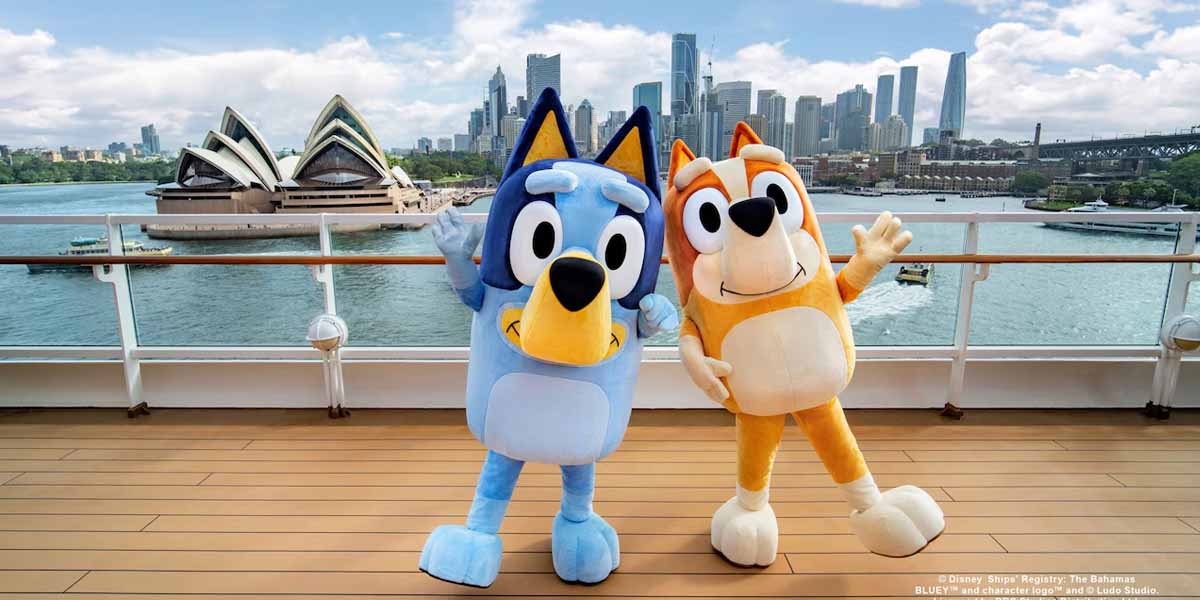
If you thought the lines for Avatar Flight of Passage were daunting, grab a “sticky simian” and brace yourself. The biggest star in the world isn’t a Marvel superhero or a Jedi Knight—it’s a six-year-old Blue Heeler from Brisbane. As Walt Disney World prepares for the grand opening of “Bluey’s Wild World” at Disney’s Animal Kingdom on May 26, 2026, a wave of “Heeler-mania” is about to crash into the park’s fragile infrastructure.
While parents are ecstatic at the prospect of their toddlers finally meeting Bluey and Bingo “for real life,” theme park experts are sounding a high-decibel alarm. By placing this global juggernaut in the park’s most isolated corner—Rafiki’s Planet Watch—Disney has created a “two-point backup” system that could turn a magical meet-and-greet into a multi-hour logistical nightmare.
The Disneyland Warning: A “Bluey Fiasco” in Fantasyland
To understand why Animal Kingdom is currently in the “danger zone,” we only have to look west. On March 22, 2026, “Bluey’s Best Day Ever!” officially debuted at Disneyland Park in California. According to a report from Inside the Magic, the opening was nothing short of a “fiasco.”

Despite being held at the high-capacity Fantasyland Theatre, the sheer volume of fans was so overwhelming that the area hit capacity within minutes of park opening. Stroller parking allegedly stretched from “it’s a small world” all the way back to the Hub, effectively choking the park’s main thoroughfares. If the “Happiest Place on Earth” struggled with a show in a massive theater, how will Animal Kingdom handle a meet-and-greet that requires a train ride to reach?
The @FiBelleFi Prediction: The 20-Minute Train to Nowhere
The primary concern regarding the Florida debut isn’t just the popularity of the characters—it’s the math. Access to Bluey and Bingo at Animal Kingdom is gated behind the Wildlife Express Train. This 19th-century-style transport is the only way to reach the former Conservation Station, and it is already showing signs of structural fatigue under the weight of standard holiday crowds.
On February 16, 2026, popular Disney commentator @FiBelleFi posted a photo of a massive line at the Harambe station with a chilling caption:
“With no Bluey at Planetwatch, the Wildlife Express Train is posting a 20 minute wait and goes back to here on this holiday week Monday. I hope Ops has really thought this out for the addition of Bluey.”
If the train is hitting 20-minute waits when there is literally nothing new at the other end, the addition of a world-class IP like Bluey is akin to pouring a gallon of water into a thimble.
The “Two-Point Backup”: A Logistical Double-Whammy
What makes the Animal Kingdom setup particularly treacherous is the Two-Point Backup. Unlike a standard meet-and-greet, where you wait in one line and are done, the “Wild World” experience forces families into two distinct bottlenecks:

Backup Point 1: The Harambe Station (The “Gate”)
Before you even see a blue ear, you have to get to Africa. The Wildlife Express Train has a fixed capacity and a roughly 7-minute travel time. If 5,000 families decide to “Rope Drop” Bluey, the queue for the train will inevitably spill out into the Harambe walkways, potentially blocking the entrance to Kilimanjaro Safaris and creating a gridlock that could paralyze the park’s back half.
Backup Point 2: Conservation Station (The “Trap”)
Once you disembark from the train, the real wait begins. Disney has rethemed the interior of the station into an interactive hub featuring:

- “Butterfly Keepy Uppy”: An animal-themed twist on the classic game.
- Dance Parties: Guided by the “P.A.C.K. Team” (Playful Animal Crew for Kids).
- The Main Meet-and-Greet: The photo-op with Bluey and Bingo.
Because Rafiki’s Planet Watch is an island accessible only by rail, guests are essentially “trapped” once they arrive. If the wait to meet Bluey is 120 minutes, a family can’t just walk away to get a snack or find a different ride. They are committed. To leave, they must join a third massive line: the one to ride the train back to the mainland.
“Jumping Junction” and the Australian Expansion
In an effort to add more “capacity” to the area, Disney is also launching “Jumping Junction,” a new outdoor space featuring animals native to Australia. This area replaces the former Affection Section petting zoo, which quietly closed on February 23, 2026.
While the addition of kangaroos or wallabies provides a nice thematic tie-in to Bluey’s Brisbane roots, it doesn’t solve the core transportation issue. Whether guests are there for the goats or the Heelers, the train remains the only straw through which this massive crowd must be sucked.
The “Cool Kids’ Summer” Context
The opening of Bluey’s Wild World on May 26 is the cornerstone of Walt Disney World’s “Cool Kids’ Summer” promotion. With the Tropical Americas construction (replacing DinoLand U.S.A.) already reducing the park’s total usable acreage, the pressure on the remaining lands is immense.

Disney is clearly banking on Bluey to act as a “people eater,” drawing thousands of guests away from the crowded paths of Discovery Island and Pandora. However, if the “people eater” is located across a narrow bridge (the train tracks), it could inadvertently create a dam that causes the rest of the park to overflow.
Survival Tips for the Heeler Rush
If you are determined to visit Bluey during the opening weeks, you need a tactical plan:

- Skip the Safari: For the first time in history, the “correct” move at Animal Kingdom rope drop might be to ignore the animals and head straight for the train station in Africa.
- The “One-Hour” Rule: If the line for the train is already 30 minutes, assume the wait at the other end is at least double that. If you have small children, ask yourself whether you’re prepared for a three-hour round-trip.
- App Mastery: Watch the My Disney Experience app religiously. If the train wait disappears, it usually means the line has been “cut” because the area at the other end is at capacity.
- Wait for the “Afternoon Lull”: Rafiki’s Planet Watch historically thins out after 3:00 p.m. as families head back for naps. However, with Bluey in the mix, the “lull” may be a myth of the past.
Conclusion: A Brave New World (of Backups)
There is no denying that Bluey belongs in the Disney Parks. The show’s heart, humor, and massive global reach make it a perfect fit for Disney’s Animal Kingdom’s “edutainment” mission. But as we saw in Disneyland, the popularity of this magnitude requires more than just a dance floor—it requires a release valve.

As the sun rises on May 26, 2026, the Wildlife Express Train won’t just be carrying guests to a conservation center; it will be carrying the weight of the park’s entire summer strategy. For the sake of every parent in a Bluey shirt, we hope “Ops” has indeed thought this out.
Are you planning to brave the train for Bluey this summer? Or will you be sticking to the “Keepy Uppy” in your own backyard? Let us know in the comments below!