Universal Alters Its Most Famous, Decades-Old Attraction

A quiet update at Universal Studios Hollywood is drawing renewed attention to one of the theme park industry’s oldest attractions.
The Universal Studio Tour has served as the park’s defining experience for decades, carrying guests through active soundstages, backlot streets, and large-scale movie scenes.
The attraction has never remained static. Its route and show elements have shifted repeatedly as Universal introduces new films, new technology, and new ways to present Hollywood storytelling.
Another change has now been confirmed.

Universal’s Backlot Tour Has Changed for Decades
The Universal Studio Tour officially opened in 1964. Backlot visits had existed earlier, but they were informal experiences offered during the silent-film era when guests occasionally watched productions being filmed.
Universal formalized the tour under studio head Lew Wasserman. Trams transported visitors through the working lot.
The concept proved popular because it blurred the line between a theme park attraction and a real film studio. Guests could see authentic sets while also encountering staged moments created specifically for the tour.
Universal gradually expanded those moments.

The 1970s and 1980s introduced elaborate practical effects scenes. A collapsing bridge sequence and a sudden flash flood became defining moments of the tour and remain operational today.
Later decades brought film-inspired additions designed to mirror Universal’s biggest franchises. Encounters tied to Jaws, King Kong, and Fast & Furious were incorporated along the route.
Not every addition lasted forever.
In 2025, Universal removed Fast & Furious—Supercharged from the Studio Tour. The sequence had operated for 10 years and featured characters including Luke Hobbs, Roman Pearce, and Letty Ortiz.
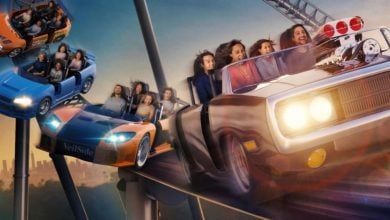
The closure came as Universal prepares to open Fast & Furious: Hollywood Drift, the park’s first high-speed outdoor roller coaster.
With that section gone, attention turned to other parts of the Studio Tour.
Universal Confirms New Format for Studio Tour Scene
Universal Studios Hollywood has now confirmed another update to the attraction.
The park’s official website states that the King Kong 360 segment will no longer use 3D projection.
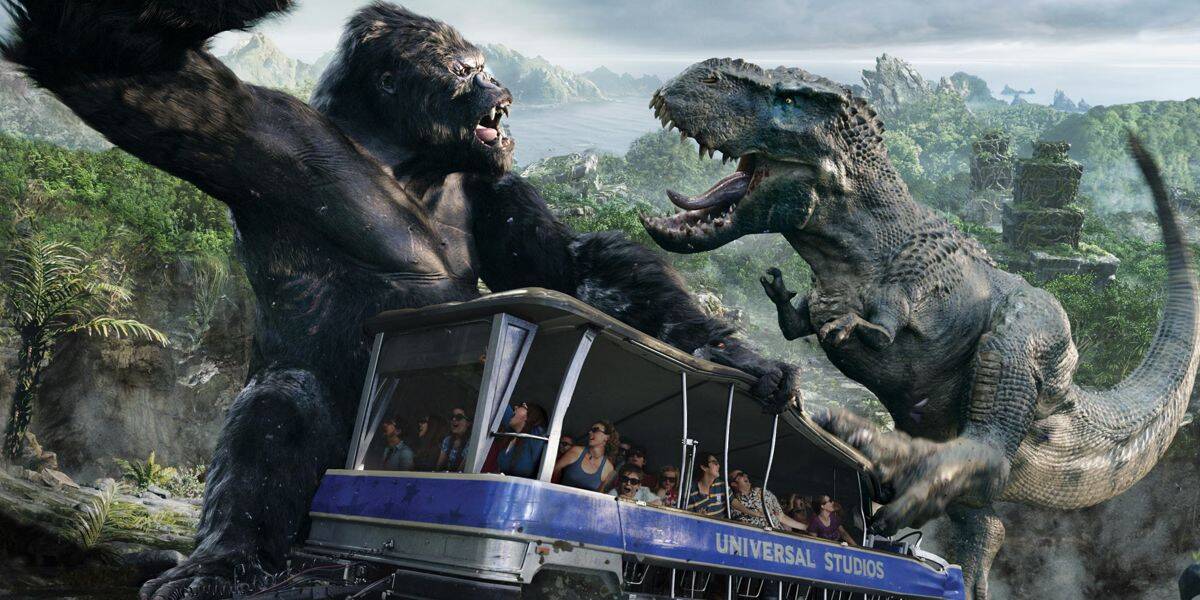
Previously, guests wore 3D glasses during the sequence. Inside the enclosed tunnel, riders witnessed “a terrifying struggle between a 35-foot T-Rex and the 8th wonder of the world – King Kong.”
The scene will now play in 2D.
King Kong 360 debuted in 2010 and quickly became one of the most technologically ambitious parts of the tour. Giant projection screens surround the tram, creating the illusion that guests are trapped inside a chaotic jungle battle.
The segment had recently closed temporarily, which sparked speculation that Universal was preparing to modify it.
Here’s a look at the new 2D format of King Kong 360 on the Studio Tour. The picture is super clean and crisp in person.
@UniStudios
Here’s a look at the new 2D format of King Kong 360 on the Studio Tour. The picture is super clean and crisp in person. @UniStudios pic.twitter.com/7nczdL8CO7
— Inside Universal (@insideuniversal) March 11, 2026
The updated listing confirms that the 3D element has been removed.
Videos shared from the revised tour show the scene playing without glasses. Viewers have described the new footage as “super clean and crisp” in person.
The decision reflects a broader shift across theme parks.
Several attractions that once relied on 3D have moved away from the format. Remy’s Ratatouille Adventure at EPCOT recently dropped its 3D presentation, and the version at Walt Disney Studios Park — soon to become Disney Adventure World — in Disneyland Paris has done the same.

Universal has also adjusted other attractions in the past. Harry Potter and the Forbidden Journey originally included 3D projection before the park removed the feature shortly after opening.
Three-dimensional ride technology has become divisive among guests. Some report headaches or nausea when motion simulation and 3D visuals are combined.
Others believe screen-heavy attractions have replaced the practical effects and animatronics that once defined theme park rides.
That debate has surfaced again following the latest Studio Tour update.
“Bring back the gigantic animatronic that used to break!” wrote one X user. “With modern technology it should run smoother! We have robots nowadays!”

Others argue the attraction should be replaced entirely.
“Just put something else in then,” another fan wrote. “Watering down rides is not the way to extend their lives.”
For now, however, the segment remains part of the Studio Tour.
Following the update, only two attractions at Universal Studios Hollywood still use glasses-based visuals: TRANSFORMERS: The Ride-3D and Mario Kart: Bowser’s Challenge.
DreamWorks Theatre Featuring Kung Fu Panda achieves a similar immersive effect using a 180-degree panoramic screen and projection technology rather than traditional 3D glasses.
The Studio Tour continues to evolve — just as it has since the 1960s.
What’s your favorite part of the Universal Studio Tour?